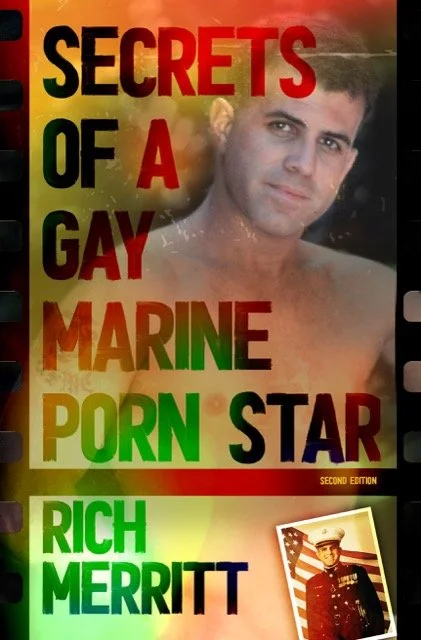
Secrets of a Gay Porn Star (Second Edition)
Here's the true story of Rich Merritt — the good son, the teacher's pet, the model Christian student who spent the first two decades of his life inside a fundamentalist cult that taught him gay people were worthy of death. The Marine captain who served under Don't Ask, Don't Tell while secretly shooting gay porn films — a dangerous rebellion against the institutions that had tried to dictate his life.
When The New York Times Magazine profiled him anonymously on its cover, the walls between his worlds came crashing down. The gay press outed the porn. The Marines came asking questions. And the man who had spent his entire life performing different versions of himself for different audiences suddenly had nowhere left to hide.
What followed was a spectacular unraveling — addiction, a shattered career, a suicide attempt, and a fight for survival that nearly killed him. By turns harrowing and heartbreaking, angry and darkly funny, Secrets of a Gay Marine Porn Star is the story of a man who refused to let anyone — gay or straight, fundamentalist or liberal — define who he was allowed to be.
This second edition includes revelations that The New York Times does not want you to know — and the confession Merritt wasn't ready to make the first time around.
“Readers don't just discover a memoirist — the memoirist discovers himself. And any life worth examining is worth a second look. Rich Merritt is honest, hilarious, and even less interested in behaving this time around."
— Greg Cope White. Author of The Pink Marine; writer, Netflix's Boots
A former Marine chronicles his life of service as a closeted gay man during the 1990s.
In the second edition of his memoir, Merritt opens with the behind-the-scenes story of what really happened during his infamous photo shoot and subsequent New York Times article in 1998. Raised in a deeply conservative Christian fundamentalist household and educated at Bob Jones University, the author observes that his early experiences shaped his morals, politics, and views on homosexuality in ways that would take years to untangle. During his service, “Don’t Ask, Don’t Tell,” a policy instituted during the Clinton administration that prohibited LGBTQ+ service members from serving openly, became a defining reality of his military career. As the years went on, he began to struggle in the restrictive environment, suffocated by the constant need to suppress his gay identity. This edition expands on the role of his best friend, Gary Fullerton, who became a grounding force in his life and a reminder of the importance of connection and community. Even with that support, Merritt’s journey remained complicated. He worked briefly as an escort and performed in several adult films; in a way, these experiences served as acts of rebellion against the rigid expectations and limitations he labored under while in the Marines. Throughout his service, he struggled with alcohol abuse and eventually drug abuseas well, which ultimately cost him a long-term relationship. Eventually, he decided to seek help and attend rehab. As Merritt acknowledges, there’s rarely a perfect happy ending to a life story, since it depends largely on where the storyteller chooses to stop. In this instance, the ending is quite sad but also sounds a hopeful note as the author reflects on the lessons he’s learned and the resilience he’s found along the way.
Merritt is a gifted storyteller, and his memoir reflects that—there’s rarely a moment in which the narrative loses momentum as he leads readers through the many dramatic, painful, and often surprising events that served to shape him into the person he is now. Even when he’s discussing some of the more shocking moments of his life, his honesty and vulnerability make it difficult not to empathize with him. Merritt doesn’t shy away from his mistakes or the darker parts of his past; rather, he takes accountability for the choices he’s made and the consequences that followed. That isn’t to say there isn’t some discomfort in reading about some of the mistakes Merritt made, and it’s important to acknowledge the harm that can’t be undone. The memoir is an important reminder that people are complicated, imperfect, and capable of growth. The greatest strength of the book is its importance as a piece of queer history; Merritt’s story provides a deeply personal look at what so many other LGBTQ+ people experience (especially those who grew up in religious or restrictive environments). His insights provide a firsthand account of life as a gay man during the 1990s, when contracting AIDS was still considered a death sentence and Don’t Ask, Don’t Tell reigned supreme. More than anything, it’s a story about survival, self-acceptance, and the realization that, despite our differences and mistakes, “we are all connected.”
An absolutely invaluable firsthand account of LGBTQ+ history.
— Kirkus Review